In-depth regulatory breakdowns, technical whitepapers, and IoT distribution architectures for enterprise water managers, industrial facilities, and civic utilities.
Groundwater Compliance
March 2024 / Updated 2026 5 min read
The CGWA NOC Isn't a Formality Anymore — What Every Groundwater User in India Needs to Know
The Central Ground Water Authority (CGWA) has steadily tightened what "compliant" actually means. Discover why paper-based logbooks fail under recent amendments, the strict 50 m³/day continuous DWLR mandates, and how automated hardware shut-off protects enterprises from lakh-rupee penalties.
India Loses 38% of Its Treated Water Before It Reaches a Tap — Here's How IoT Is Closing the Gap
Every day, Indian utilities treat millions of litres of water and lose more than a third before it ever reaches consumers. Learn the crucial difference between 75% physical leaks and 25% commercial losses, global benchmarks from Manila to Dhaka, and how District Metered Areas with IoT telemetry make NRW a live actionable number.
38% National NRW Average 75% Physical Pipe Losses DMA Ultrasonic Monitoring
Modernize Your Water Infrastructure with AquaSense
Whether navigating complex CGWA NOC compliance or tackling utility water losses with smart telemetry, our engineering team is here to assist your facility.
The CGWA NOC Isn't a Formality Anymore — What Every Groundwater User in India Needs to Know
Technical Advisory 5 min read Industrial & Commercial Guidance
If your business, facility, or housing society draws groundwater through a borewell, there's a regulatory shift you may not have fully clocked: the Central Ground Water Authority (CGWA) has been steadily tightening what "compliant" actually means — and manual, paper-based compliance is no longer enough to meet it.
Why Groundwater Regulation Is Getting Stricter
Groundwater supplies a large share of India's water needs, and in many regions, extraction has outpaced natural recharge for years. Under the Environment (Protection) Act, 1986, the CGWA regulates groundwater withdrawal to prevent over-exploitation — issuing No Objection Certificates (NOCs) that specify exactly how much groundwater a project or industry is permitted to draw, based on whether the local area is classified safe, semi-critical, critical, or over-exploited.
The rules aren't static. A March 2023 amendment to the CGWA's guidelines reshaped several key requirements:
NOC is now mandatory for most industrial and commercial extraction — required once a facility draws beyond a modest daily threshold, with narrow exemptions (e.g. drinking-water-only use up to 5 m³/day).
Commercial entities must submit online water audit reports, which the CGWA or State Ground Water Authority publishes publicly.
Bulk water suppliers using private tankers must obtain an NOC specifically for groundwater abstraction.
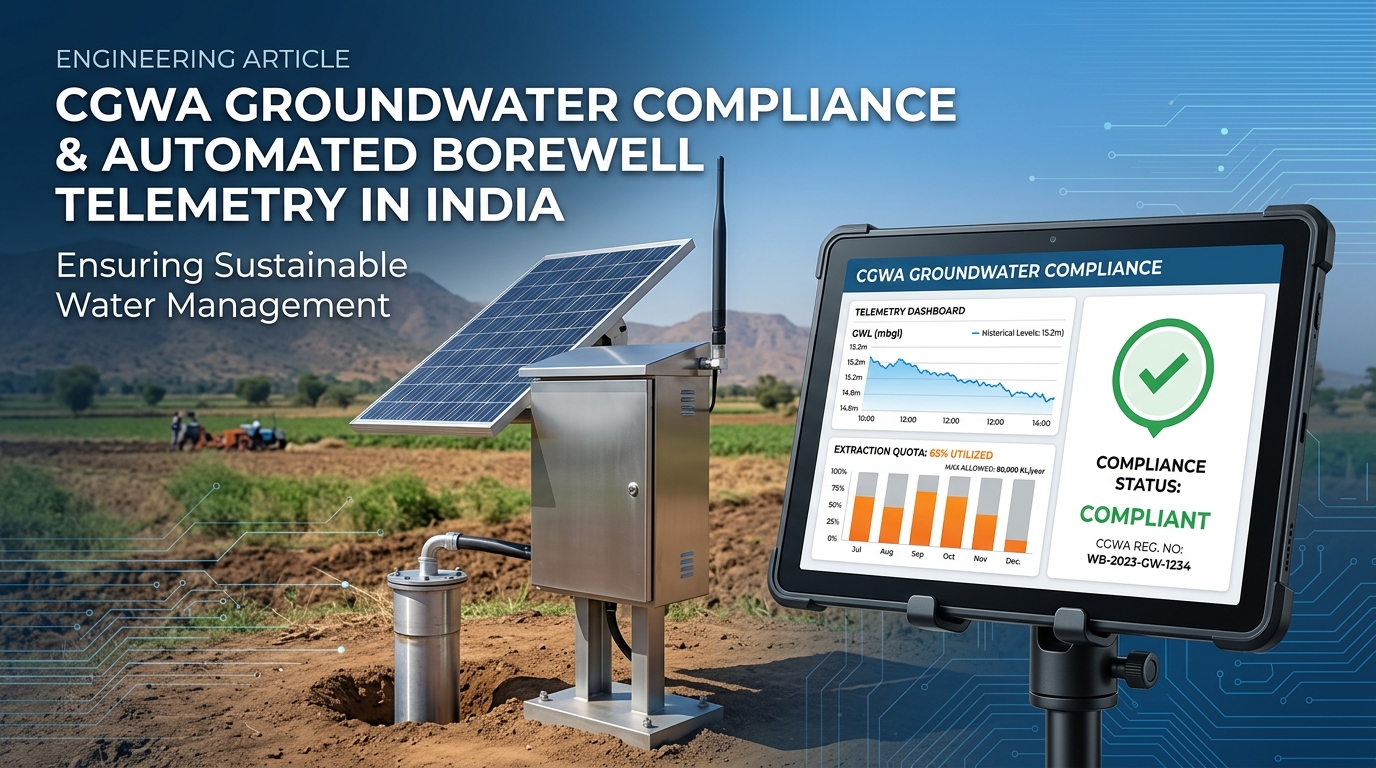
Facilities drawing beyond 50 cubic metres/day are required to construct a dedicated observation well (piezometer) and install a digital water level recorder (DWLR) for continuous telemetry monitoring — with real-time data access provided directly to the CGWA repository.
50 m³/day
Continuous DWLR & Piezometer Mandatory
>10 m³/day
General Industrial Extraction NOC Required
5 m³/day
Exemption Limit (Drinking/Domestic Only)
What Happens If You Don't Comply
The CGWA has shown it's willing to enforce this rigorously. In one enforcement round, it listed over 2,000 projects and units — including large, well-known corporations — that had failed to renew their groundwater NOCs, warning that continued extraction without a valid NOC would be treated as illegal abstraction with penal action under the Environment (Protection) Act.
High Penalty Exposure
Failure to renew on time can mean environmental compensation charges for the entire lapsed period — not just a minor late fee. Separately, failing to install the required IoT-based groundwater monitoring system where mandated can attract fines running into lakhs of rupees.
Why Manual Monitoring Fails This Standard
Most facilities that ran into trouble weren't trying to violate the rules — they were relying on processes that were never built for this level of scrutiny:
Extraction limits enforced by policy, not by hardware: Without automated shut-off, "don't exceed the sanctioned quantity" depends entirely on an operator remembering to check a gauge and manually stopping the pump.
Data collected periodically, reported annually: By the time an over-extraction trend shows up in a manual log, months of non-compliance have already accumulated.
No direct data feed to the regulator: Even a diligent facility with good records has no way to demonstrate compliance to the CGWA without manual document submission.
Continuous Groundwater Compliance: How the Data Flows
Borewell
Flow Meter / DWLR
Telemetry (4G/GPRS)
Cloud Platform
CGWA-Ready Dashboard
What Automated Borewell Compliance Looks Like
The shift the CGWA's rules are effectively forcing is the same shift happening across water infrastructure generally: from monitoring to automated control.
Continuous Telemetry: A digital water level recorder (DWLR) or flow meter transmits real extraction data continuously, satisfying the "continuous monitoring" requirement by design rather than manual estimation.
Automated Shut-off at Sanctioned Limits: Rather than relying on an operator to track daily/annual quotas, an automated controller (like AquaSense ATBC) enforces the sanctioned extraction limit directly — making over-extraction structurally impossible.
Dashboard-based Audit Trails: A real-time dashboard logs extraction history, pump run-time, and tank levels to generate digital, verifiable records for CGWA online audits.
Retrofit-Friendly Deployment: Facilities don't need to rip out existing borewell infrastructure — automation modules can be retrofitted directly into an existing starter panel.
Navigating CGWA NOC Renewal or Audit?
AquaSense ATBC automates groundwater compliance, daily logging, and pump protection.
Water IoT & Distribution Architecture
India Loses 38% of Its Treated Water Before It Reaches a Tap — Here's How IoT Is Closing the Gap
Industry Whitepaper 6 min read Municipal & Township Focus
Every day, Indian water utilities treat millions of litres of water, pump it into distribution networks, and lose more than a third of it before it ever reaches a consumer. This is Non-Revenue Water (NRW) — treated water that's produced but never billed.
In India, NRW averages around 38%, well above the global acceptable benchmark of 15–20% and higher than the World Bank's reported global average of 30–35%. In some cities, independent estimates put the real figure closer to 50–65% once illegal connections and unmetered usage are accounted for.
38%
India National Average NRW
15–20%
Global Acceptable Benchmark
5%
Dhaka Target Post-Smart Metering
What's Actually Being Lost?
NRW isn't one problem — it's three distinct issues bundled together:
Physical losses (~75% of total NRW): Leaking distribution pipes, burst mains, reservoir overflow, and ageing distribution infrastructure. Studies estimate physical leakage accounts for roughly three-quarters of all lost water in South Asian cities.
Commercial losses (~25%): Illegal connections, meter tampering, unauthorized tanker tapping, and outdated mechanical meters that underreport actual consumption.
Unbilled authorized consumption: Water legitimately used (such as municipal firefighting and park watering) but never tracked or invoiced.
The Missing Link: Real-Time Visibility
A utility that can't see where water is going in real time can't tell whether it's losing water to a cracked pipe on Tuesday or an unmetered tanker fill on Thursday — it just sees a gaping deficit in the balance sheet at the end of the month.
Why the Old Approach Doesn't Scale
For decades, the standard response to NRW has been periodic manual meter reading, spot leak inspections, and after-the-fact billing reconciliation. This fails because:
Monthly meter readings: A leak that started on day one isn't detected until the bill arrives 30 days later, wasting millions of litres.
Estimated billing: Leads to disputes with consumers and widespread revenue leakage.
No network isolation: Maintenance crews cannot isolate which branch is losing water without physically walking miles of buried pipeline.
However, international benchmarks prove this can be solved. Dhaka cut its NRW from ~40% to 5% through universal metering and systematic leak management. Manila Water reduced NRW from 63% to under 13%. Domestically, utilities in Jamshedpur have demonstrated that similar gains are achievable in India.
What IoT-Based Metering Actually Changes
The shift from manual to connected infrastructure fundamentally transforms water management:
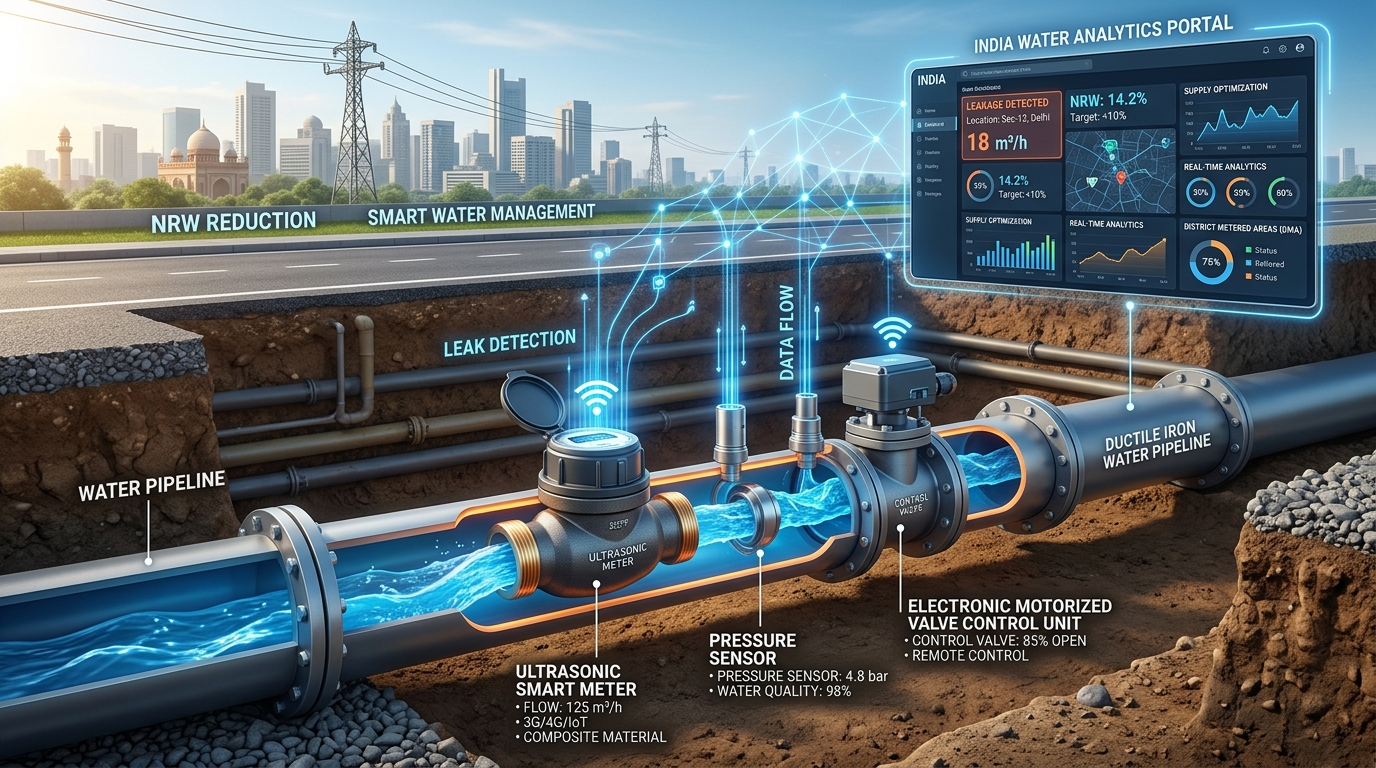
Real-time consumption data: Smart, tamper-resistant ultrasonic flow meters report usage continuously, flagging leaks or bursts within hours, not weeks.
Automated, dispute-free billing: Billing is generated directly from digital flow logs rather than manual estimations, eliminating customer disputes.
Remote valve control: Combining metering with motorized valve actuation means utilities or township managers can shut off supply remotely for leaks, tampering, or non-payment without deploying field staff.
District Metered Areas (DMA) leak isolation: Segmenting the network into monitored zones flags discrepancies immediately between water injected and water consumed in that zone.
NRW as a live dashboard metric: Rather than a retrospective quarterly calculation, NRW becomes a live operational KPI visible 24/7.
Want to Plug Water Losses Across Your Campus or Utility?